
Spotlight on Tim Tynan
History teacher Tim Tynan has been a pillar of The Academy community since he joined us in Fall of 2000. As he begins his twenty-sixth year, he reflects on the importance of history, his experience at the academy, and his teaching philosophy.
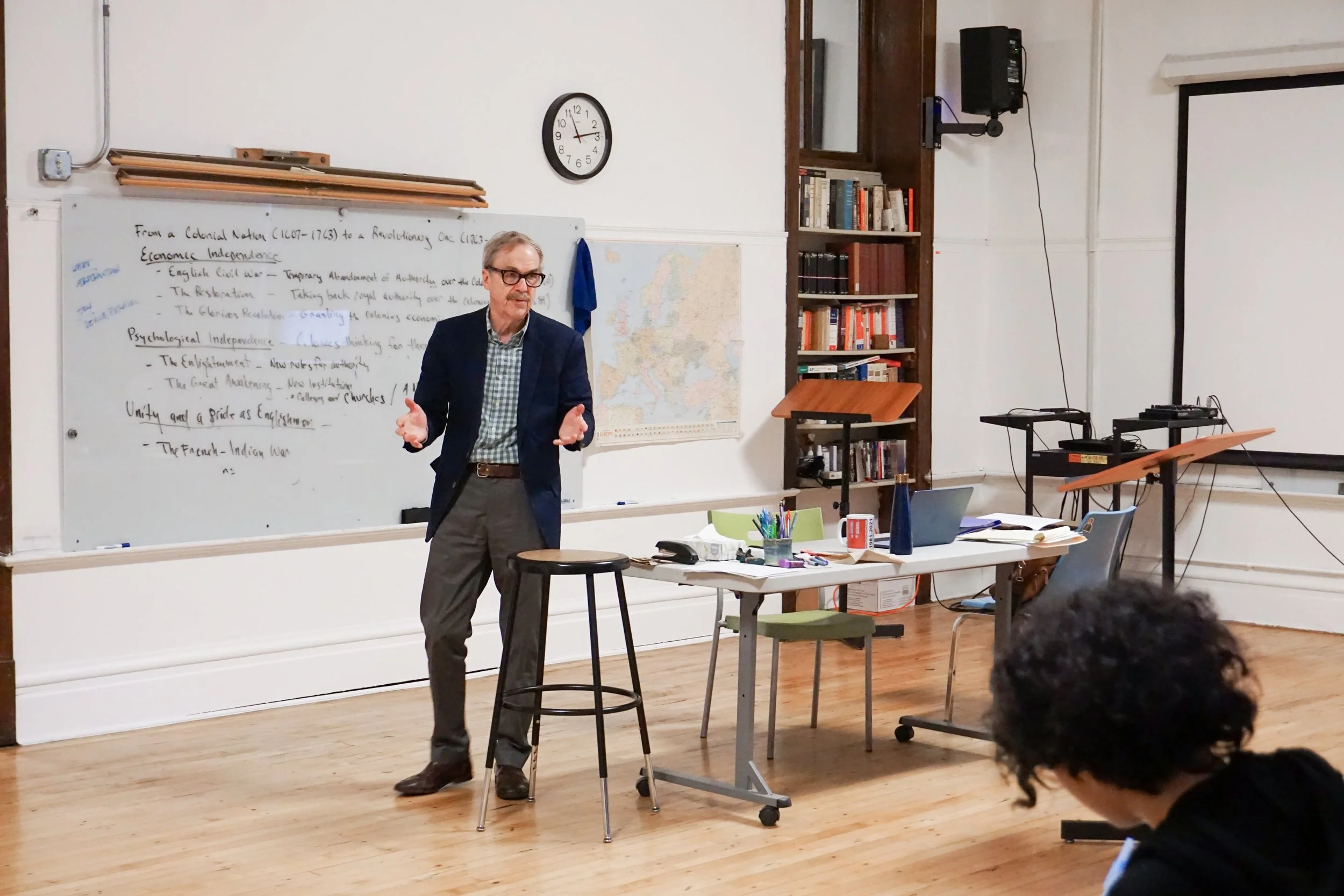
How long have you been teaching at The Academy and what are some of your favorite memories from your tenure here?
This is my twenty-sixth year at the Academy. During those years, there were two occasions that required me to address the entire Academy community, including parents, alumni, and members of the board. The first was when I was asked to deliver the commencement address to the graduates of 2011. The next was when I received the legacy award during the 2017 Showcase. I remember both occasions quite favorably.
“I don’t know if students realize what a unique and privileged situation they are in at the Academy, having such intimate access to a really extraordinary pool of teachers. ”
Do you remember your first day at The Academy? What was it like?
Not really. But all first days are alike, always the same apprehension and sense of not feeling grounded until one can comfortably apply names to those new faces. It never varies. My first year as a full-time teacher, however, was memorable – and fraught. This was the 2001 - 2002 school year, and roughly three weeks into it, the twin towers were attacked. The event happened during first period. Of course, the teaching day was shot, and the entire faculty effectively threw itself into grief management. It seemed the impact from that day never subsided for the remainder of the year. This was particularly true of the freshmen, the class of 2005, but I always see them as the “class of 911.” I was teaching World History then, along with the AP course on European history I taught as a part-time hire the previous year. It was also the year I introduced Modern American History through Film. This was one of my more difficult years as a teacher. After four years in the City Colleges of Chicago, I had no experience teaching high school freshmen and had much to learn. Modern American had no textbook and no set film list. I never knew which film I would be showing week-to-week. Then the world took a sudden turn on a single morning in September, and it affected the rest of the school year. The sudden loss of equilibrium never fully restored itself, not in our nation and not, it seemed to me in our school. The class of 2005 bore the worst of it, first the attack at the start of their freshmen year, followed by the war in Iraq in their sophomore year that lasted past their graduation. One of the graduates suffered a tragedy that I’d sooner not talk about. For that and other very good reasons, this group, the class of 911, really haunts me.
Have you seen the students change over the years?
There are not as many nerds as there used to be. I’m talking about the type of student who takes a great deal of pride and pleasure in possessing information about some of the most arcane subjects and talking about them with tremendous enthusiasm. It was great listening to their discussions between classes, topping one other with their supply facts and anecdotes about a shared interest. There are a few in every graduating class, but not as many as there used to be. Apparently, keeping information in one’s head isn’t as important or necessary as it once was.
What is the pedagogy or philosophy of teaching you bring into the classroom?
Well, I love my subject, which has served me well, and I hope I bring enough knowledge about it to the classroom. I think I do, because I never tire of reading history, even on topics I know quite well, such as the French Revolution or the Cold War. No matter how acquainted I am with the content of these events, I always learn something new and add it to that year’s curriculum. Sometimes this new information causes me to change my perspective about a topic, which is why I discourage students from relying on a single source for history. And this includes relying exclusively on me, even though I do try to maintain a disinterested, that is, impartial approach to all topics. One of the advantages of teaching the past is not having a personal stake in the outcome, which is why I never express my personal political views to the class or discuss politics and ideologies as anything other than aspects of history. Of course I am not without these things; it’s just that I don’t want to impose them on a captive audience. If I’m moved to instill anything at all on students, let it be skepticism rather than certainty about politics and social panaceas. It keeps them from falling prey to charlatans and shoddy ideas. I’m also wary of conspiracy theories that attribute present conditions to some prior plan perfectly executed. History has too many examples of nations and individuals whose designs for civilizations failed to materialize. More often the results are unintended consequences, which, along with cautionary stories of human folly, make up the bulk of historical studies.
My pedagogical approach is borrowed from my experience with the history professors I admired as an undergrad and graduate student. They were masters of their subjects and great storytellers. Their lectures and assigned readings gave breadth to my own understanding of the past. Remembering them now, what fascinates me most is that I never knew their politics. And this made their presentation of the past seem more reliable. I feel their influence even in my own delivery of information, so I guess that makes my pedagogy antiquated. I’m not sure how history is taught in elementary classrooms or other high schools these days. Students tell me of having learned about individual topics, such as slavery, the fight for gay and women’s rights, and the Holocaust, but complain that there was no bridge between these and other events in history. That bridge is something I hope I can supply. That, along with the content of these topics and the context that gave rise to them. Bridges are the connections that link all history together and move it along. If a student is aware of how one historical context connects to another, that student will never be lost. He, she, or they can always go backwards and forward with a full sense of chronology, which is something I really hope they will acquire from my classes.
At the beginning of the school year, I tell students and parents that my classes emphasize the four “Cs”: content, context, connection, and chronology. Because of the strict attention I pay to them, however, I can’t get as far into the present as other history classes. There is so much content in modern American and European history, and the pace of chronology is so rapid, that it is difficult to cover our more contemporary world with the attention to detail it requires. I can’t find any shortcuts and wouldn’t take them if I could. But the temptation is there because even in Modern American History through Film, I can only reach the mid-seventies. This, I’ll, admit, is where my pedagogical approach falls short.
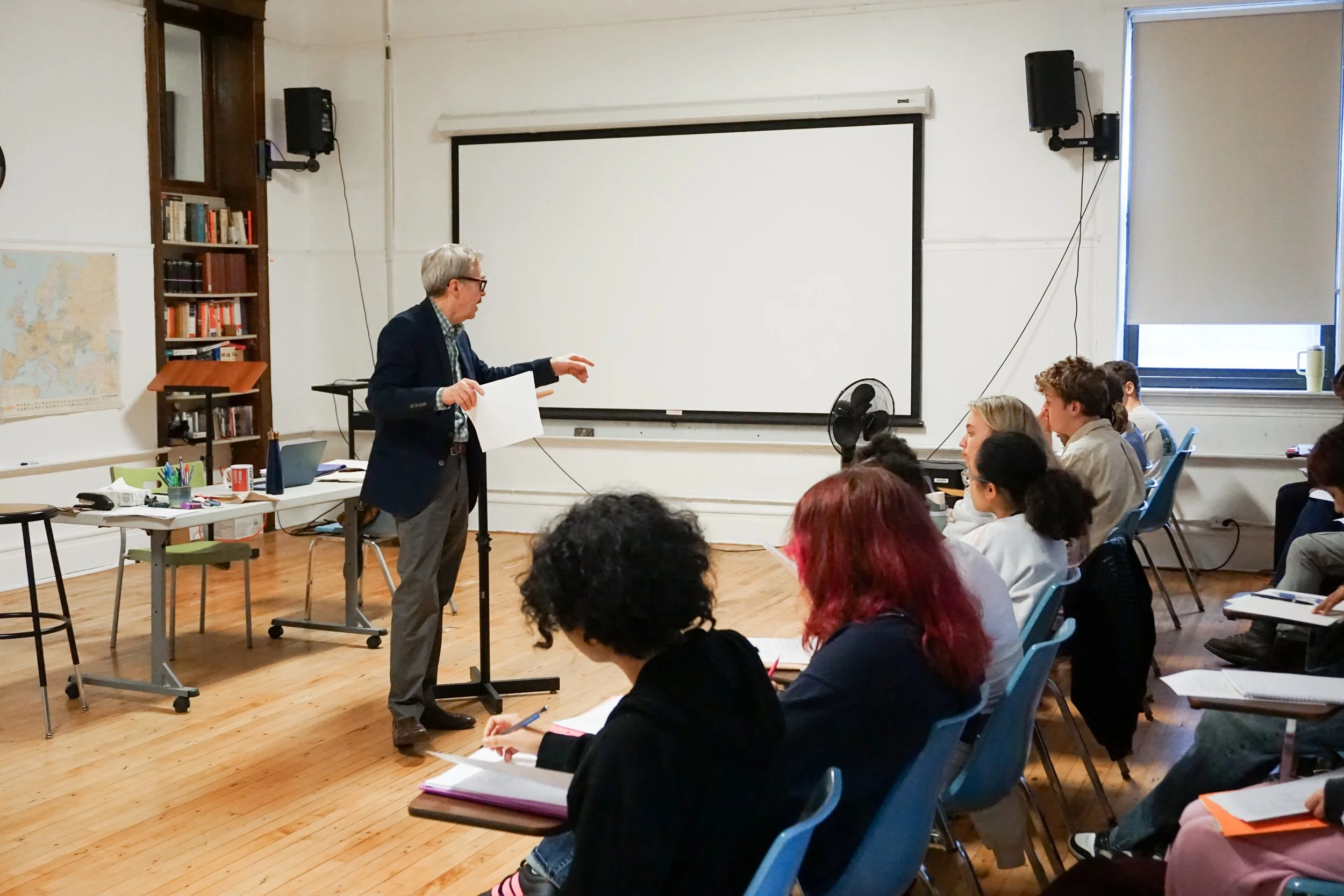
Why do you think it’s important to study history?
History, we are told, is all about memorizing facts and dates. As reductive and dismissive as that sounds, it’s essentially true. History requires facts and dates to keep it coherent. If memorizing them improves one’s power of memory, that’s all to the good. One’s opinions are also made more persuasive when they are supported by verifiable facts committed to memory rather than by personal experiences, feelings, and prejudices. And while not all dates are important, some, such as July 14, 1789, or September 1, 1939, are turning points, whose long- term effects are undeniable. A handful of such dates provide a proper ordering of chronology. I can think of nothing more humiliating for an adult than putting the Second World War before the French Revolution or the American Civil War before the War for Independence. Aside from these practical considerations, what’s most important is turning those memorized facts and dates into a comprehensive perspective about the past, so that one sees how everything fits, all the causes and effects are in place, and one can go backwards and forwards from any significant event in history and understand why we now live the way we do.
There’s also the equanimity that comes from knowing that no crisis, whether war, revolution, pandemic, or natural disaster, is unique. History teaches us that humanity has experienced these onslaughts before, and that rare is the civilization that has ever been completely obliterated by them. That’s the psychological advantage of knowing history, the sobering effect. History is rife with many examples of human folly, egregious evil, and unimaginable carnage, none of which resulting in the apocalypse. Those who lived through them had good reason to believe they were facing a final reckoning. But live through them they did, embittered, broken, or emboldened, perhaps. But they survived. And the proof of that survival is recorded history – a record of endurance. At least this is the sense of equanimity I have received from knowing history. It keeps me from feeling rattled by the next crisis or believing the entire system has broken down when a national election doesn’t meet my desires. It provides many salient examples of people and places who have been victimized by history only to come back stronger in broken places. Such examples give plausible grounds for hope that today’s conflicts may find resolutions tomorrow. And that is no small advantage—or solace.
Modern American History through Film is a unique class you teach. Why do you think film is such a useful tool to look at history?
Older films are tremendous tools for revealing history because they are not aware of doing so. Their intent is to entertain, build myths, or escape into fantasy, not consciously reflect history. But that is exactly what they do. The myths they build and the fantasies they create reveal much about the aspirations and anxieties America was experiencing when these films were in production. So, we study seven decades of American life in this class to see how the movies do it. And the emphasis is on history, not film appreciation. Although I try to expose students to some of the best films Hollywood had to offer, and we watch them in their entirety, our class discussions are less about the art of film, and more for how film functions as historical testimonials. This approach is based on my long-held conviction about the interplay of art and history that has always interested me.
I proposed this class to earn a full-time position at the Academy. But I conceived it even before I became a teacher. It stemmed from how I first became interested in history as a high school senior, which was preceded by my interest in music. Listening to the great works, I would wonder why the style and content of Bach and Handel sounded so different from that of Beethoven and Berlioz, or why the dynamics of Mozart and Beethoven were so clearly divergent even though they shared roughly the same period. I discovered that events, such as the Reformation, the French Revolution, and the emergence of nationalism, had a tremendous bearing on the works of these and other composers, and that these events were reflected in the sound and scale of their music, so I wanted to learn more about them and became a reader of history. In the process, I came to understand that all history has an impact on the arts, and that all art is, in some measure, a reflection of historical experiences.
Today, the best reflection that experience is found in popular culture, of which movies along with songs are very much a part. I remember perceiving this in the movies I watched growing up in the sixties, particularly the late sixties when the civil rights movement turned to Black Power, and the outcry against the Vietnam War was gaining force. The decade turned very intense, and films of that period seemed to project that intensity. There was an edge to them that wasn’t there in the earlier films of the decade. Movies like Bonnie and Clyde, The Graduate, In the Heat of the Night, and Easy Rider perfectly reflected the rage and confrontation that I was sensing in those years. Even traditional genres, like the western, reflected that edge, especially those of director Sergio Leone, not so much because they were noticeably more violent, but because they established the anti-hero as a fixed film protagonist. This made sense because the world was full of anti-heroes then.
Rewatching movies from previous decades, I saw how much they too were affected by history, how noticeably the Great Depression, or World War II, or the Cold War bore on the tone and content of the films from those eras. This led me to conceive of a class that studies American history through the media of textbook and film, with the latter being a superb vehicle for explaining the past because it isn’t consciously doing so. The Hollywood movie is America talking in its sleep, exposing the then prevailing attitudes about race, family life, and gender roles. As products of popular culture, their aim is to turn a profit, and the best way to do that is to tap into the anxieties and aspirations of their audience. In that process, the movies lay bare the national conscience of the thirties, forties, or fifties with the unguarded immediacy that a history textbook or classroom documentary can’t provide. In their analysis of America’s national conscience in different historical eras, students watch our selection of movies, not only as historians, but as sociologists, psychologists, and even anthropologists, as well, and thus become more active participants rather than passive listeners to another one of my lectures. This, I think, is what sets Modern American History through Film apart from the other history classes I teach at the Academy.
In your mind, what is unique about The Academy?
The intimacy of the place, all due to the size of the building. Outside of the classroom, there are rarely spaces where teacher or student can hide. One is always exposed or coming into contact with someone from our population. As a result, we become quickly familiar with one another. I’ve come to know students who’ve never taken my classes. That intimacy endures throughout the entire year. On the first day of each school year, it always feels like I’m boarding a ship for a ten-month voyage, with occasional ports of call during holiday, winter, and summer breaks.
We also have an exceptionally fine faculty, many of them true and dedicated scholars of their fields, but also possessing a command of knowledge outside that field. I’ve worked with different teachers and professors from other schools and found many of them surprisingly petty and dull. That has never been the case with this group. I don’t know if students realize what a unique and privileged situation they are in at the Academy, having such intimate access to a really extraordinary pool of teachers.
Is there anything else you’d like to be asked or like to share?
I think I’ve already demonstrated the occupational hazard afflicting teachers – talking too much -so I’ll simply stop here. Thanks for the opportunity to explore what I do. It’s been great.
