
Chicago As Our Classroom: Immersive Trip to the Newberry Library
From 15th-century work to modern comics, our Graphic Novel students explored centuries of beautiful work.
In November, our Graphic Novel students traded the studio for stacks and took a deeply immersive field trip to the Newberry Library. It was the kind of real-world classroom field trip that reminds us what it means to learn in Chicago, not just about it.
The Newberry is no ordinary library. Founded in 1887 thanks to a bequest from Chicago civic pioneer Walter Loomis Newberry, it has stood for more than a century as a free, independent, research-level humanities library. Today, the collection reaches far and wide: roughly 1.5 million books, millions of manuscript pages, hundreds of thousands of historical maps, rare prints, archives, and more — spanning six centuries of human experience.
“At The Academy, Chicago is our classroom, and places like the Newberry show just how literal that can be.”
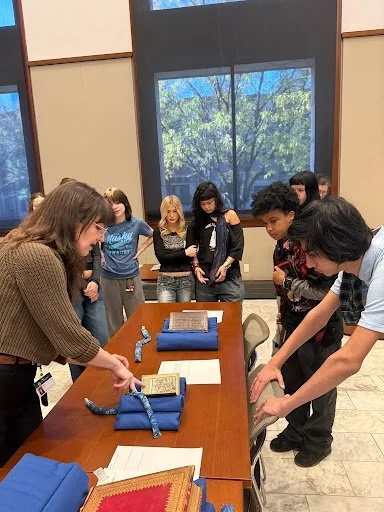
Academy students review special collections.
For Academy students, especially those using comics and graphic storytelling as their medium, the Newberry’s archives are a goldmine: a living bridge connecting medieval manuscripts, woodblock novels, early illustrated books, maps, and modern storytelling.
Our class held in their hands a 15th-century medieval “Book of Hours”: vellum pages penned on animal skin, shimmering inks made with lapis lazuli, gold dust, ornamental fonts, and devotional drawings illustrating religious stories. We talked about how monks spent months (sometimes years) copying such work by hand, blending illustration, text, and design — a precursor to today’s comics creators combining art and narrative.
Students explored a first edition of Alice’s Adventures in Wonderland with original illustrations by John Tenniel, sometimes called the “suppressed Alice.” Students recognized how much Tenniel’s art shaped the world’s image of Wonderland. Think: the grinning Cheshire Cat. The mushroom-sitting Caterpillar. All born on those pages.

A 15th century medieval religious manuscript Book of Hours.
We got a peek into materials from modern comics, including drafts and a course syllabus by Chris Ware for a class at School of the Art Institute of Chicago; a 1929 wood-cut “novel” by Lynd Ward (a major influence on graphic-novel history); several works by Indigenous writers/illustrators; and vintage “classics illustrated” comics from the 1950s adapting literary classics like Moby Dick and The Count of Monte Cristo. With each item, students traced a creative lineage: from monks to modern graphic-novel artists — from hand-lettered devotionals to woodcuts to comic-book page turns.
At The Academy, we believe Chicago is our classroom, and places like the Newberry show just how literal that can be. By immersing students in physical artifacts that pre-date comics by centuries, we help them appreciate craft, history, and the deep roots of storytelling.
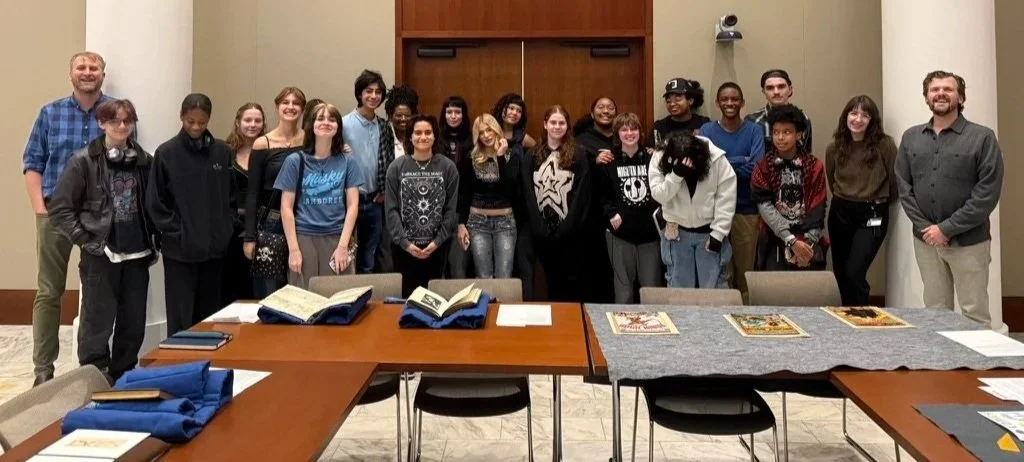
With expert guidance from Newberry curators, our students left with more than just inspiration. They gained respect for the labor behind each stroke of ink, the evolution of narrative form, and the power of design and words to shape meaning across time.
Want to support future student experiences both in and outside the walls of The Academy? Consider supporting The Chicago Academy for the Arts with a gift today: https://www.chicagoacademyforthearts.org/donate